


If you set up a worksheet with row or column headings, these headings will not be visible when you scroll down or to the right. MS Excel provides a handy solution to this problem with freezing panes. Freezing panes keeps the headings visible while you’re scrolling through the worksheet.
Follow the steps mentioned below to freeze panes.
Select the First row or First Column or the row Below, which you want to freeze, or Column right to area, which you want to freeze.
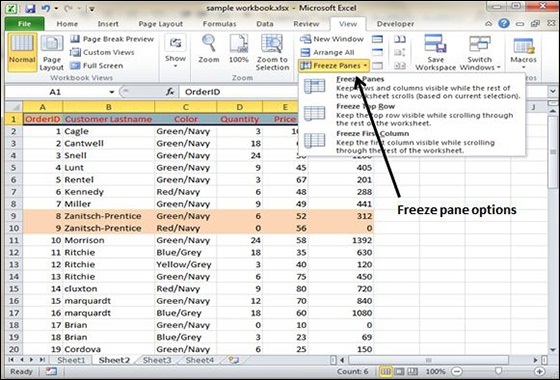
Choose View Tab » Freeze Panes.
Select the suitable option −
Freeze Panes − To freeze area of cells.
Freeze Top Row − To freeze first row of worksheet.
Freeze First Column − To freeze first Column of worksheet.
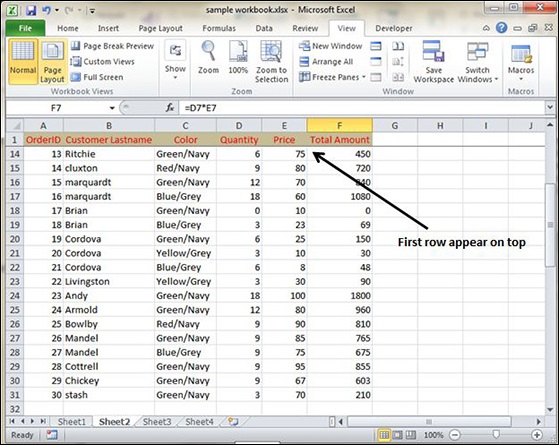
If you have selected Freeze top row you can see the first row appears at the top, after scrolling also. See the below screen-shot.
To unfreeze Panes, choose View Tab » Unfreeze Panes.
A cryptocurrency is a digital or virtual currency that is secured by cryptography, which makes it nearly impossible to counterfeit or double-spend. Many cryptocurrencies are decentralized networks based on blockchain technology—a distributed ledger enforced by a disparate network of computers. A defining feature of cryptocurrencies is that they are generally not issued by any central authority, rendering them theoretically immune to government interference or manipulation.
Cryptocurrencies are systems that allow for the secure payments online which are denominated in terms of virtual "tokens," which are represented by ledger entries internal to the system. "Crypto" refers to the various encryption algorithms and cryptographic techniques that safeguard these entries, such as elliptical curve encryption, public-private key pairs, and hashing functions.
The first blockchain-based cryptocurrency was Bitcoin, which still remains the most popular and most valuable. Today, there are thousands of alternate cryptocurrencies with various functions and specifications. Some of these are clones or forks of Bitcoin, while others are new currencies that were built from scratch.
Bitcoin was launched in 2009 by an individual or group known by the pseudonym "Satoshi Nakamoto."1 As of Nov. 2019, there were over 18 million bitcoins in circulation with a total market value of around $146 billion.2
Some of the competing cryptocurrencies spawned by Bitcoin’s success, known as "altcoins," include Litecoin, Peercoin, and Namecoin, as well as Ethereum, Cardano, and EOS. Today, the aggregate value of all the cryptocurrencies in existence is around $214 billion—Bitcoin currently represents more than 68% of the total value.3


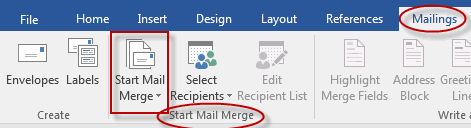
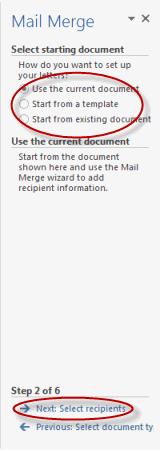
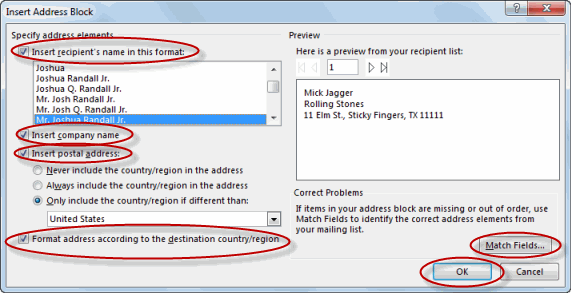
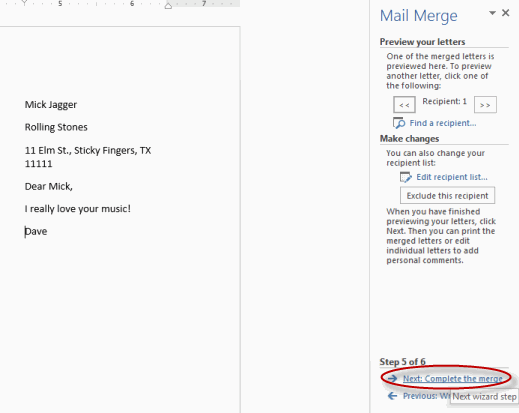
Mail Merge is most often used to print or email form letters to multiple recipients. Using Mail Merge, you can easily customize form letters for individual recipients. Mail merge is also used to create envelopes or labels in bulk.
This feature works the same in all modern versions of Microsoft Word: 2010, 2013, and 2016.













Memory is a key element to computing and there are a number of different types to keep your machine running smoothly. Some are designed for short-term tasks and others are for long-term use, such as storage, but both are equally important in terms of the software and hardware of a computer.
Introduction:
The term Application refers to Software which is a set of instructions or code written in a program for executing a task or an operation in a Computer. Applications play a vital role in a Computer as it is an end-user program that enables the users to do many things in a system. The application programs are designed and developed to run in a System Software which is an Operating system. An Operating System is system software that enables al the applications programs to run and execute various tasks in a Computer system. The GUI based applications carries out various tasks in a Computer like creating documents, playing games, browsing and many more.
Application Software Overview:
Application software’s are the end-user programs designed to enhance the productivity in various fields of work. The applications are used for creating documents, spreadsheets, databases, and publications, doing online research, sending email, designing graphics, running businesses, and also playing games. Application software’s are designed to perform a specific task and can be as simple as a calculator application or as complex as a word processing application. The applications are designed with built-in functions and properties so to easily carry out all the operations. One of the most popular and widely used applications is Microsoft word processor where you can do calculations, copy, paste, delete, and add colors and pictures, change the appearance by using its built-in properties. Not only Word processor applications but there are several other productivity programs like Graphical software, Photo studio, Antivirus and many more that are packed as an Application software.
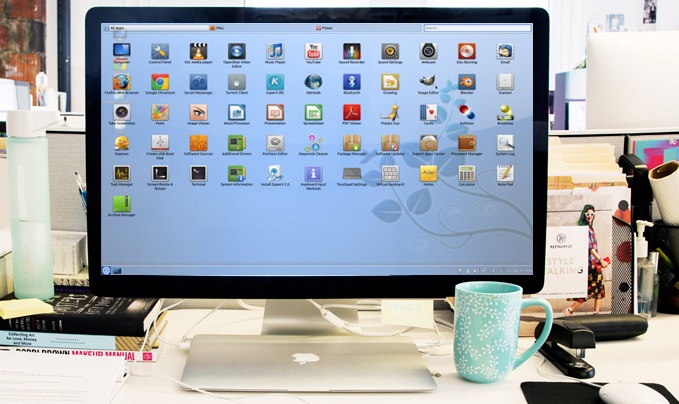
Application software cannot run itself as it requires system software for executing the programs. System software like Windows, Mac, Linux and many more helps the application software’s to run and execute in a Computer. As a Computer needs an Operating system, an Operating system needs Application software’s, so without applications the computer is nothing but a blank page. Since the system software’s also integrates some built-in application programs when installed on a computer that can be used. But there are several applications like Microsoft Office which is a complete suite of programs that includes Excel, Power point, Access etc, Graphic suites like Adobe Creative suite with various applications for creating and editing images, Audio master suite for sound production, Video editing applications, Security software’s and most importantly Web-browser which is also application software.
Application Software can be divided into two broad categories are System Software and Applications Software.
Operating systems like Windows, Mac, Linux, and UNIX are the best examples that manage all the programs in a Computer. Since there are other systems software’s that help the OS to perform all the tasks like BIOS (Basic Input/output system) that manages data flow between OS and other attached devices such as keyboard, mouse, hard drives etc. Boot program loads the Operating system to RAM, an Assembler takes basic instructions and converts them to machine language to perform operations and a Device manager controls all the devices attached to Computer. The utility software’s like disk derangement, system restore, compilers and debuggers are also installed on the Operating system software.
Application suites are packed with multiple programs with user interfaces, features and functions to interact with the users. Some of them are Microsoft Office, Adobe Creativity suite, Security suite, Gaming apps and many more.
Enterprise Software labels the organization requirements and also manages data flow in a huge environment. It may be an automated billing system, e-mail marketing, business intelligence and Content management.
Enterprise Infrastructure Software provides the capabilities required to support enterprise software systems. It is mainly used for businesses, society or Organization for network security, surveillance system, transportation, sewage, communication, electricity and water that need high investment for the systems.
Educational Software includes all the contents of different subjects that can be used by a student or any individuals. There are several websites providing educational software about various topics and vast database makes it an easy to use application.
Multimedia Software is used for development of media in our day to day life. There are various audio, video and image editing tools, printing media that can be used to maximize the growth of a business.
Content Access Software is used to access the contents in a website for publishing digital contents and entertainment.
Information Software is used for addressing the needs of an individual by creating and managing information for individual projects within the department. It may be the word processors, spreadsheets, e-mail or blog clients etc.
Conclusion:
Application software is the lifeline for a user as it creates an interface to communicate with the Computer by using various application programs. Each and Every application program is run by the system software which is the Operating system. You can run loads of applications in your Computer and can perform various tasks from creating documents to playing games. I hope you like this article about the Computer Application and its types, if you have any issues kindly write into my mail.
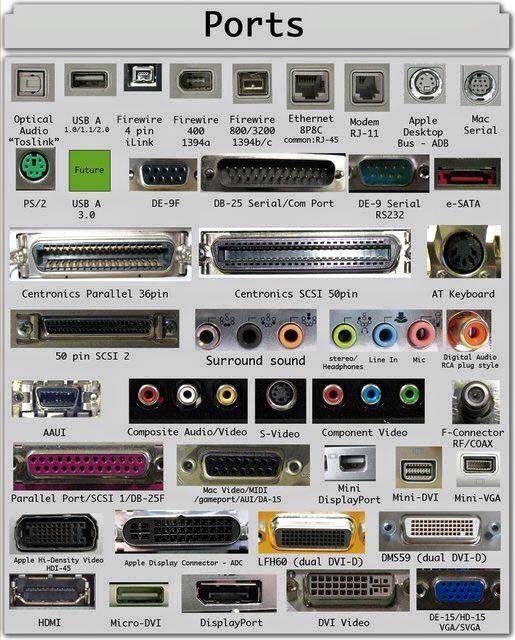
16 Types of Computer Ports and Their Functions 09/10/2020 A Computer Port is an interface or a point of connection between the computer a...


' x='0' y='0' height='100%25' width='100%25' xlink%3Ahref='data%3Aimage/jpeg;base64,/9j/4AAQSkZJRgABAQAAAQABAAD/2wBDABALDA4MChAODQ4SERATGCgaGBYWGDEjJR0oOjM9PDkzODdASFxOQERXRTc4UG1RV19iZ2hnPk1xeXBkeFxlZ2P/2wBDARESEhgVGC8aGi9jQjhCY2NjY2NjY2NjY2NjY2NjY2NjY2NjY2NjY2NjY2NjY2NjY2NjY2NjY2NjY2NjY2NjY2P/wAARCAAFAAoDASIAAhEBAxEB/8QAFgABAQEAAAAAAAAAAAAAAAAAAAIE/8QAHxAAAQMDBQAAAAAAAAAAAAAAAgABIQMREhMUIjFx/8QAFQEBAQAAAAAAAAAAAAAAAAAAAgT/xAAYEQEAAwEAAAAAAAAAAAAAAAABAAIRMf/aAAwDAQACEQMRAD8AyvRGubZXlry/XirbmPHXOIREVwJLa6cn/9k='%3E%3C/image%3E%3C/svg%3E)

